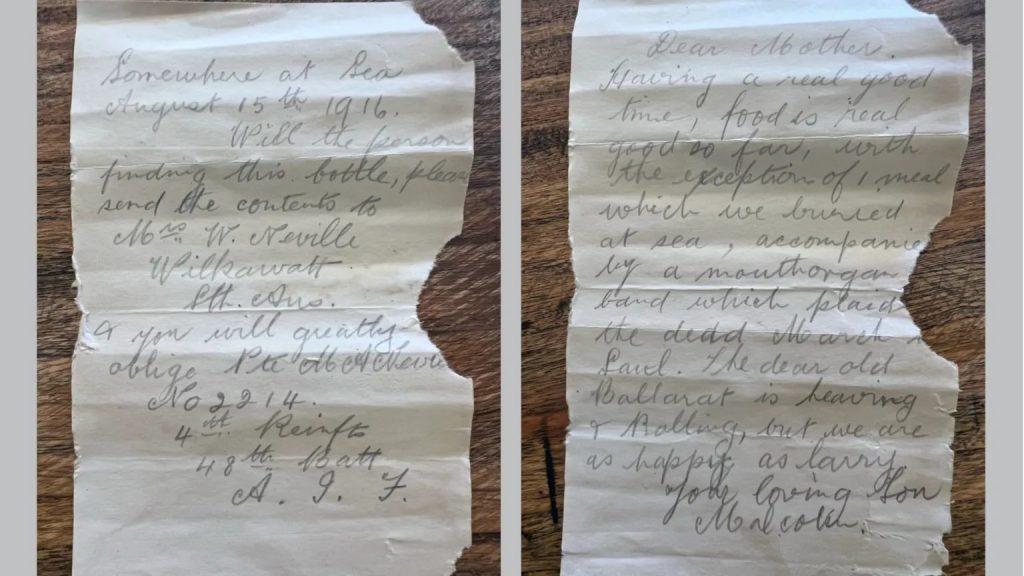
Two handwritten messages from Australian soldiers dating back to 1916 have been discovered inside a glass bottle on the country’s south-western coast — more than a century after they were written.
The cheerful notes were penned by Private Malcolm Neville and Private William Harley just days into their voyage to France to fight in World War One. In his letter, Neville wrote to his mother that the food on board was “real good” and that they were “as happy as Larry.” Sadly, he was killed in action a few months later at the age of 28. Harley, then 37, survived the war and eventually returned home.
The remarkable find was made earlier this month by Deb Brown and her family while cleaning up litter along Wharton Beach, near Esperance, in Western Australia. Brown said she spotted the thick glass bottle lying in the sand during one of their regular quad bike trips.
“We never pass up any rubbish, so when we saw the bottle, we picked it up — it was just lying there waiting for us,” she told the Associated Press.
Although the paper inside was wet, both letters were still readable. Determined to return them to their rightful families, Brown began searching for the soldiers’ descendants.
Using the address written in Neville’s note, she tracked down his great-nephew, Herbie Neville, who described the discovery as “unbelievable” for their family. His aunt, Marian Davies, vividly remembers her uncle leaving for war — and never coming home.
Harley’s letter, meanwhile, was addressed simply to whoever might find the bottle. His granddaughter, Ann Turner, said she and her relatives were “absolutely stunned” to receive it.
“It feels like a miracle — as if our grandfather has reached out to us from the grave,” Turner told ABC. “It’s so emotional, especially knowing the other soldier wrote to his mother, while our grandfather had already lost his.”
According to Harley’s note, the bottle was thrown overboard “somewhere in the Bight,” referring to the Great Australian Bight. Experts believe it may have floated only a short distance before being buried in the sand, where it remained hidden for over 100 years before being discovered.