


Scientists in China have identified a new amphibian species that lived entirely in the ocean around 237 million years ago, making it the only known amphibian believed to have been fully adapted to marine life.
The discovery was announced on Oct 26 by a research team from the Guizhou Geological Museum and Peking University, whose findings were published in the scientific journal Nature Ecology & Evolution.
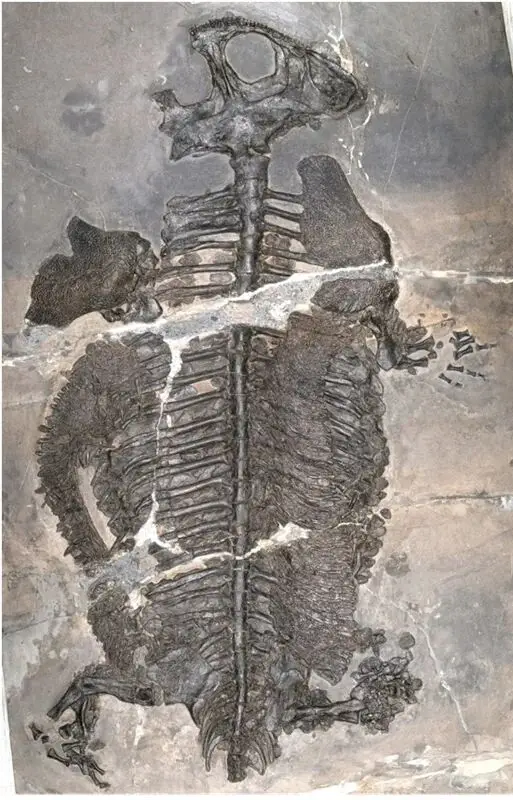
Named Gerrothorax maritimus, the species lived during the Late Triassic period. Its fossils were discovered in Late Triassic rock formations in Guanling, Guizhou province.
Unlike most modern amphibians, which depend on freshwater and moist skin to regulate water balance and support gas exchange, this ancient species possessed specialised features that allowed it to survive in a marine environment.
Armoured Body Helped It Survive In Seawater
The amphibian had a flattened body, a broad head, a large mouth and a body covered in thick bony armour.
Researchers believe its heavy protective plating helped prevent excessive water loss in the salty marine environment, addressing one of the major challenges amphibians face in seawater.
Most amphibians absorb water through their skin and rely partly on it for gas exchange. In seawater, the difference in salt concentration can cause water to leave their bodies, making long-term survival difficult.
Although a small number of modern frogs can tolerate brackish water for limited periods, they generally cannot remain indefinitely in highly saline seawater.
Gerrothorax maritimus, however, retained functional gills into adulthood, allowing it to breathe underwater rather than relying on lungs alone.
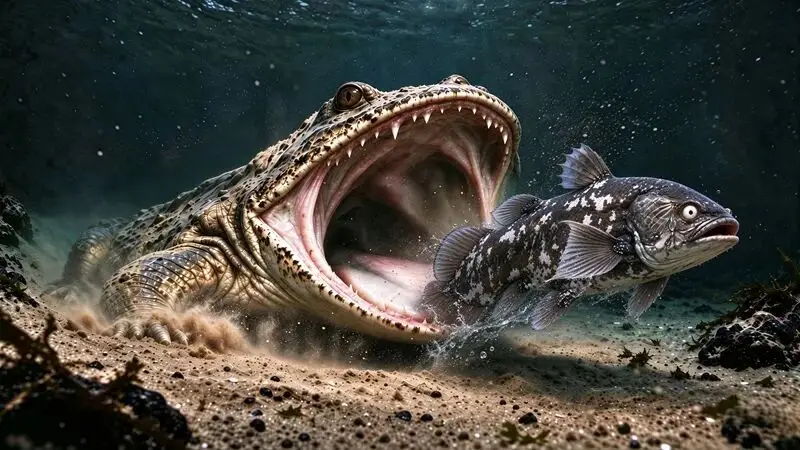
A Predator Adapted To Life On The Seabed
The species also had strong, well-developed gill arches and a large mouth. These features suggest it could use suction to capture prey, potentially allowing it to ambush animals from the seabed.
Its combination of a protective bony covering and adult gills points to a survival strategy very different from that of most amphibians alive today.
The discovery offers new insights into how ancient vertebrates adapted to challenging marine environments and highlights the diversity of amphibian lifestyles during the Triassic period.
The fossil holotype is held by the Guizhou Geological Museum.
