Health authorities are working to contain a potential spread of hantavirus after new suspected cases were reported on Friday, extending concern beyond a luxury cruise ship where the outbreak first emerged.
The initial cluster was detected aboard the Dutch-flagged cruise vessel MV Hondius, where several passengers fell ill during its voyage. According to the World Health Organization (WHO), six of eight suspected cases on board have now been confirmed, with three deaths reported.
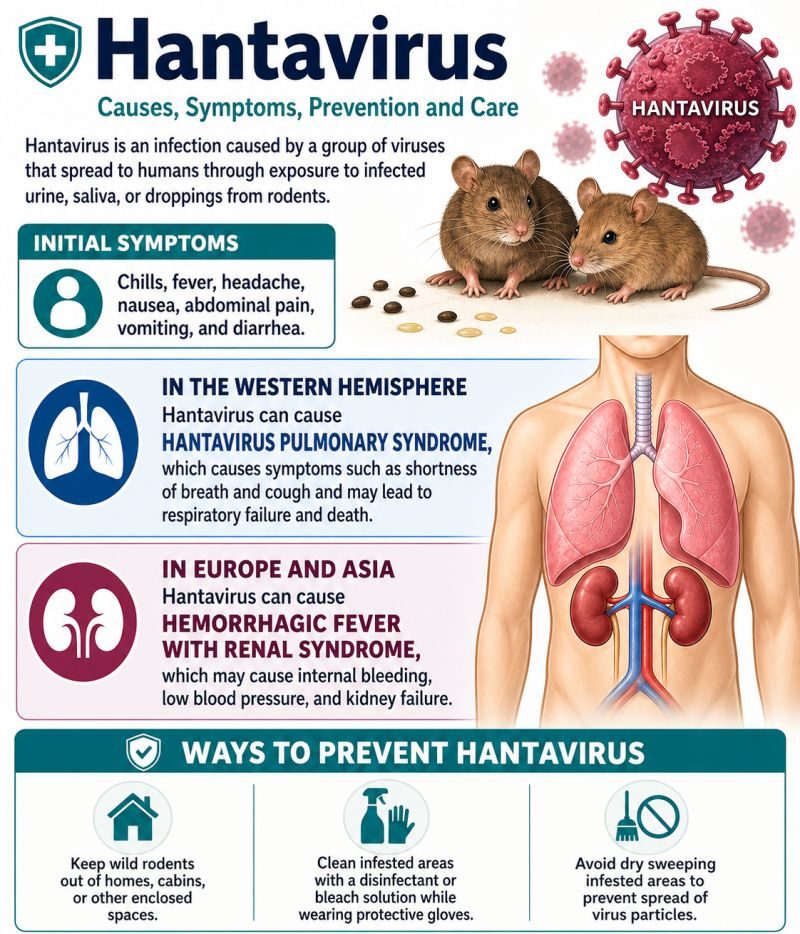
The virus involved has been identified as the Andes strain of hantavirus, a rare variant that can, in limited circumstances, spread between humans through close and prolonged contact. The WHO has maintained that the overall risk to the general public remains low.
However, new suspected infections have now been reported far from the ship, including a man who fell ill after disembarking and a woman in Spain who developed symptoms after sitting near an infected passenger on a flight. Another suspected case has also emerged on the remote British territory of Tristan da Cunha.
Health officials said these incidents are geographically distant but linked through travel history involving passengers from the cruise ship, raising concerns about potential secondary transmission, although experts continue to stress that widespread contagion is unlikely.
The MV Hondius, carrying 147 passengers and crew, had travelled from Argentina through Antarctic waters before heading towards West Africa. Several passengers had already left the ship before the outbreak was confirmed, and some have since been treated in hospitals across Europe and South Africa.
Four patients remain hospitalised in the Netherlands, South Africa and Switzerland. Cruise operator Oceanwide said no symptomatic passengers remained on board as the vessel continued its journey towards Tenerife in the Canary Islands.
Health agencies, including the US Centers for Disease Control and Prevention (CDC), have activated emergency response measures and are arranging medical repatriation for exposed passengers. Those returning to the United States are expected to be quarantined in Nebraska.
In Spain, authorities confirmed a woman in Alicante is undergoing testing after showing symptoms, while a British man on Tristan da Cunha has also been flagged as a suspected case following exposure during the ship’s stopover.
Tristan da Cunha, one of the most isolated inhabited locations in the world, has heightened concerns due to its remote population and limited medical facilities.
Despite the developments, the WHO reiterated that the outbreak remains under close monitoring and that current evidence does not indicate easy or sustained human-to-human transmission in the wider community.