


China successfully launched three astronauts to its Tiangong space station on Sunday, including one crew member expected to remain in orbit for a full year — the country’s longest human space mission to date.
The historic mission marks another major step in Beijing’s ambitious plan to land astronauts on the moon by 2030 and eventually establish a permanent lunar base.
The Shenzhou-23 spacecraft blasted off at 11.08pm local time from the Jiuquan Satellite Launch Center aboard a Long March-2F Y23 rocket carrying three astronauts.

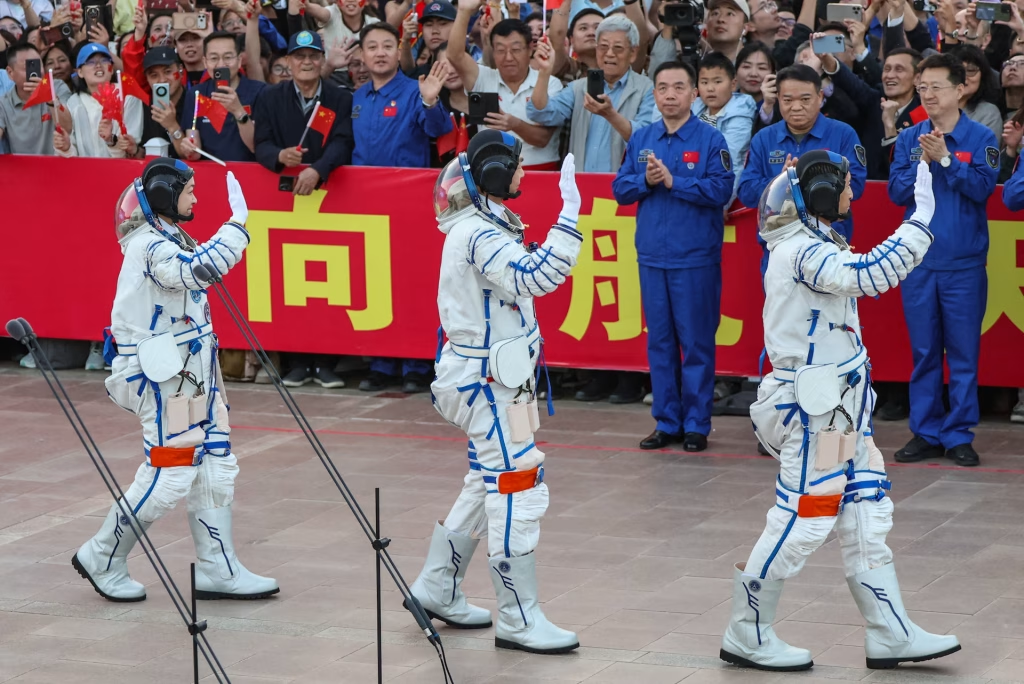
Among the crew is Li Jiaying, a former Hong Kong police inspector who became the first astronaut from Hong Kong to participate in a Chinese space mission.
The mission is commanded by Zhu Yangzhu alongside pilot Zhang Yuanzhi, both members of China’s People’s Liberation Army astronaut corps.
Chinese authorities said one astronaut will remain aboard the Tiangong space station for an entire year to study the long-term effects of space travel on the human body.
Scientists are expected to monitor radiation exposure, bone density loss, psychological stress and other physiological changes linked to prolonged stays in orbit.
The year-long mission would become one of the longest space missions ever conducted, although still shorter than the 14-and-a-half-month record set by a Russian cosmonaut in 1995.
China’s latest mission comes amid an intensifying space race with the United States, as both countries push aggressively toward future moon exploration.
NASA is aiming for a crewed moon landing by 2028 under its Artemis programme, while China has set a 2030 target for its own lunar landing mission.
The rivalry has sparked growing geopolitical tension, with US officials previously accusing Beijing of ambitions to dominate and mine lunar territory — allegations China has strongly denied.
Meanwhile, billionaire Elon Musk’s SpaceX recently completed another largely successful unmanned Starship test flight, a programme designed to support future moon missions and eventually human exploration of Mars.
China’s lunar ambitions have accelerated rapidly in recent years.
In 2024, China became the first country to retrieve samples from the far side of the moon using robotic spacecraft.
Beijing is also collaborating with Russia on plans to establish a permanent moon base by 2035.
Chinese space officials revealed that major preparations for the 2030 moon mission are already underway, including safety tests involving the Long March-10 rocket, the Mengzhou spacecraft and the Lanyue lunar lander.
The Shenzhou-23 mission will also test a rapid autonomous docking procedure with Tiangong — a key technology required for future lunar orbit operations.
In another groundbreaking experiment, China is reportedly conducting the world’s first human “artificial embryo” study in space.
Human stem cell samples were recently sent to Tiangong to help scientists understand how humans may survive, reproduce and live long-term beyond Earth.
