


A 31-year-old Chinese university lecturer has been charged with murdering his 25-year-old Chinese student and allegedly dismembering and disposing of her remains in multiple locations across South Korea.
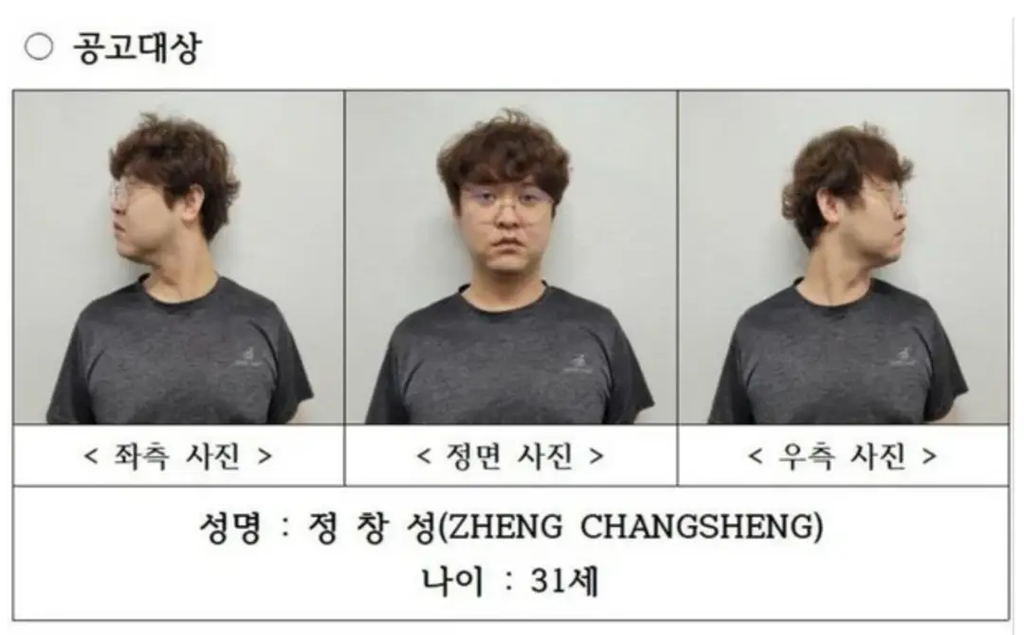
The Daegu District Prosecutors’ Office announced on September 21 that Zheng Changsheng had been indicted on charges including murder, dismemberment of a body, abandonment of a body, concealment of a body and obstructing official duties through deception.
According to prosecutors, Zheng allegedly strangled his 25-year-old girlfriend, identified by the pseudonym Wenwen, at an apartment in Hayang-eup, Gyeongsan, North Gyeongsang Province, at around 6am on August 20.
Wenwen was a Chinese international student who had previously taken one of Zheng’s university courses.
Prosecutors allege that Zheng subsequently attempted to conceal the killing by dismembering her body and disposing of the remains at various locations.
The remains were reportedly scattered across five areas, including Gyeongsan, Gyeongju and Sangju in North Gyeongsang, Daegu and Gunpo in Gyeonggi Province. The alleged disposal sites included rubbish dumps, remote wooded areas and riverbanks.
Some of the remains were also allegedly concealed inside Zheng’s own residence.
Prosecutors further allege that Zheng reported Wenwen missing to police in an attempt to mislead investigators.
He also allegedly disguised himself as a woman and travelled around Daegu carrying Wenwen’s mobile phone, reportedly in an attempt to create a false trail and confuse the investigation.
Regarding the alleged motive, prosecutors said Zheng was extremely concerned that his relationship with Wenwen would become known to others.
He reportedly feared that disclosure of the relationship could result in disciplinary action and the loss of his university lecturer position.
During the earlier police investigation, Zheng allegedly told investigators that he and Wenwen had a heated argument shortly before the killing, during which she threatened to reveal their relationship to the university.
Police subsequently reviewed CCTV footage from around the scene and gathered evidence including human remains and suspected crime-related items recovered from Zheng’s residence.
He was arrested and detained on September 4 before being handed over to prosecutors.
Zheng had also previously undergone a psychopathy assessment. According to the report, he scored below South Korea’s benchmark of 25 out of 40 for classification as psychopathic.
The Daegu District Prosecutors’ Office said it would seek appropriate punishment for the accused, stressing that serious crimes threatening public safety would be dealt with firmly.
Zheng will now face court proceedings over the charges.
